Heartbeat of the African Diaspora

It’s a very beautiful afternoon, and I’ve just had an extremely sumptuous lunch at the expansive dining hall of the newly-commissioned Qatar National Convention Centre. Besides the aesthetics of this gorgeous architectural masterpiece, I’m bowled over by the professionalism and courtesy of the staff here; everywhere I turn, someone is making a slight bow to say hello. At lunch, the waiters and waitresses offered me four or five varieties for a refill of my glass every 10 minutes. What a nice reception! But I think there was something peculiar about the waitress who served my table; she was dark-skinned, fairly tall and quite slender. I must have seen that oval-shaped head somewhere before…ah! I see the flat features of her forehead….her long fingers…her slim waistline…all I need is to hear her voice now… “Excuse me; do you mind if I ask, what country are you from?” “Kenya”. Yes, I knew it! I could easily place her somewhere in East Africa, and Kenya was my first guess. “Well done, thank you for the service; I’m Nigerian”.


me4


Lunch is over, but I can’t halt the cascade of thoughts flowing through my mind now: “How did she come here to dry, boiling hot Qatar all the way from Kenya? How long has she been here? Is she married, and if so, did she leave a husband and children behind? How often does she go back home? Do her family members know exactly what she does? Is she well-paid? Is she responsible for her family’s survival? Does she miss home? Do her family members think she’s rich? Is she rich?” I can’t control my mind right now; I recall that while checking into the Retaj Al Rayyan hotel two days ago, I ran into a sweaty exhausted man in the elevator, dressed in the hotel’s outfit. “Busy day?”, I quipped. “Very”, he replied. “We have lots of guests coming in today”. I couldn’t miss the accent or the face, so I asked: “What country are you from?” “Kenya”, he replied. “Well done, I’m Nigerian”.  Now, those are two Kenyans that I’ve met within 20 miles of each other. In New York or London, this will not be a big deal, actually such a lack of visible African presence would be a disaster, but this is Qatar where the entire population is a whooping 1.8 million people, made up of 20% Qatari citizens, 20% from other Arab nations, 20% Indian, 13% Nepali, 10% Filipino, 7% Pakistani and 5% Sri Lankan. The other 5% is composed of immigrants from several other countries most of whom are in Qatar on temporary contracts. My two Kenyan friends are clearly part of the 5%.

As the day wears on, my mind is fixed firmly on the subject of the diaspora; Qatar is one country that acutely typifies the concept of migration, much more than the United States of America. The country’s economy and social life are run almost exclusively by foreigners, perhaps with the exclusion of the local markets and a few restaurants. I repeatedly ask myself: “how did 250, 000 Indians migrate to Qatar over the last 10 odd years? What inspired 150, 000 Nepali citizens to choose such a vastly different environment from theirs? How did 125,000 Filipinos migrate in there?” But not once was I shocked that there were 4,000 South Africans in Qatar or 5,000 Nigerians in a country where temperatures often rise above 1100F; after all, I had been made to understand since I was a thumb-sucking toddler that there is no piece of land anywhere on planet Earth that doesn’t contain Nigerians, and if I ever found such a place, my best bet was to escape as quickly as possible.

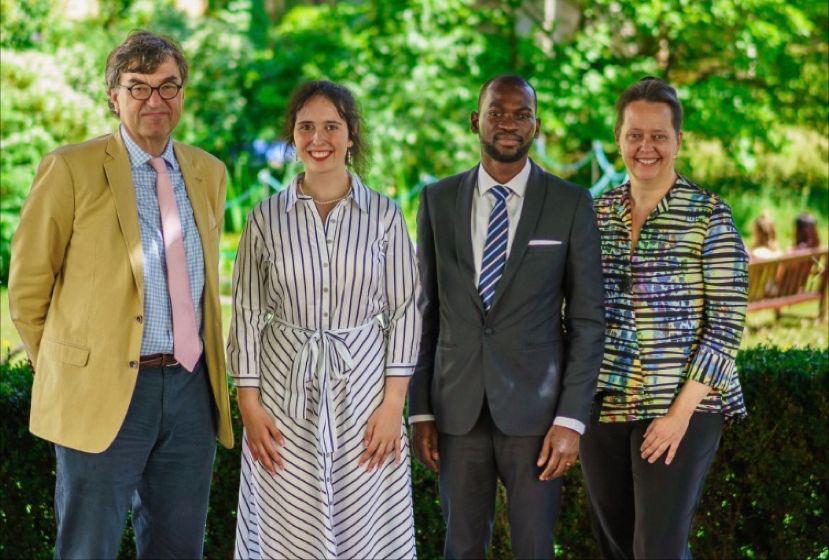
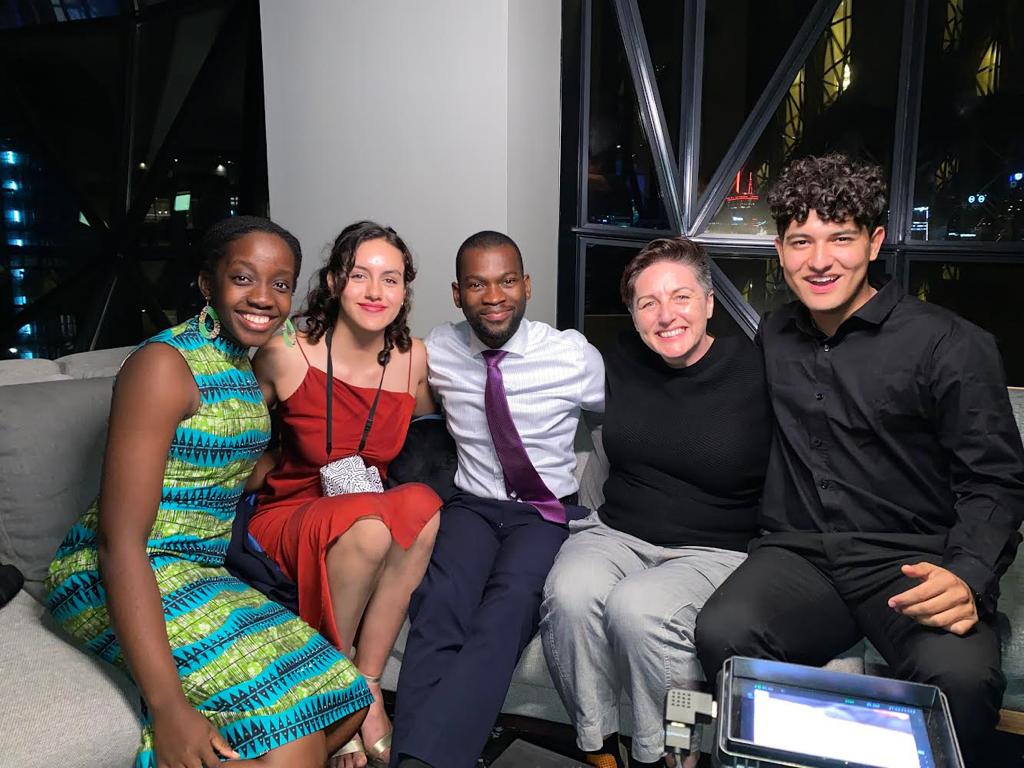
Shannon, Barin, Tola and I

I’m not so much concerned about the fact that Africans are perhaps the most adventurous migrants (not necessarily by numbers, because we can’t beat the Asians there), my concern is how and why people leave Africa. This could sound like a question with an intuitive answer, because the default position most people have is that people migrate in search of ‘greener pastures’, however it’s not always the case. There are Africans who have migrated to remote corners of the world as doctors, teachers, engineers, architects and other such skilled professionals, bringing their expertise to bear on the development needs of foreign countries. There are also those (the majority, perhaps) who have emigrated for education purposes; in the past, popular destinations were the UK and the US, but these days we can’t get enough of Indonesia, Tahiti and Uzbekistan. Sports men and women have abandoned their home countries in search of better training facilities; missionaries have braved the worst conditions in several countries to spread the gospel; music and fashion stars have found their most favourable markets to exist beyond the shores of Africa; and there are those who left their countries because they just had to leave, as a matter of survival, escaping from wars, famines, diseases, political violence, and assassination attempts.

When we run into each other at shopping malls, in our work places, at cultural events or at our various diaspora reunions, we share stories of past pain, present endurance (or pleasure) and future glory. We talk about our relatives and acquaintances back home; when last we travelled home, and when next we hope to; how considerably different life is on this side than on that side; and how our continent needs to develop quickly. Occasionally, we discuss how we can contribute to the development of our hometowns by building boreholes, endowing scholarships to school children or providing health facilities; the younger generation often discusses how they can influence the politics of their home countries and partner with non-profit organizations working ‘on the ground’. But a more pertinent question is “how are we perceived by the people back home?” The most common perception about Diaspora Africans is that they are tremendously rich; holding down fantastic jobs and eating very good food, whether or not they are schooling on financial aid or working three jobs by the side. Otherwise, why else would they call us on the phone to say “how is the enjoyment over there? Can you please send me a laptop next week?” Why else would they rent huge vans and load them up with several representatives from our tribes to welcome us at the airport when we visit home for just five days? Why do they always expect personalized gifts for every single extended family member along with their friends, if they didn’t perceive us as wealthy citizens who are enjoying all the good things of life?

IMG_4061

There is also the segment of our populations that perceive Diaspora Africans to be proud and unpatriotic. In their enlightened minds, whoever leaves the country for a few months instantly undergoes a brain metamorphosis, forgets where they come from, picks up an accent, eats foreign food, refuses to bow when they greet elders, dates white girls and loses all their morals. We are perceived as unpatriotic to our home countries because we celebrate St. Patrick’s Day with a dash of green at the local pub or because we post “Never Forgotten” on our social media sites on the anniversary of 9/11; the mere fact that we’re ‘enjoying in America’, while our friends are protesting on the streets summarizes our love (or lack thereof) for our country. Back home, they read our Facebook posts with a mixture of disgust and hatred: disgust at our excited poses beside the Statue of Liberty and hatred for the beaming white girls beside us; disgust for our comments about how unbearable the snow is, and hatred for the layers of warm clothes we put on; disgust for our endorsement of several of Barack Obama’s policies and hatred for every gay person who is a beneficiary of America’s evolution.

For all the love and hatred directed towards Africans in the diaspora, the contributions made from across several thousand miles remains unmatched. While it may be unquantifiable in monetary terms, our continent benefits immensely from the inspiration and ideas generated from the diaspora; the mere knowledge that a family member ‘escaped’ the horrors of Africa and is presently working towards a PhD in the US serves as huge motivation for several others back home. The return of famed entrepreneurs to establish companies in their home countries always brings with it the finesse and distinction of established industry best practices, serving as an eye-opener into the ways of the world. How often do we celebrate the entrance of our foreign-trained professionals into the politics of our home countries? Do we not thump our fists in the air at the prospect of having someone who has observed better economies helping to reform our governments? How about the many young students who are beneficiaries of scholarship endowments and sponsorships to conferences and seminars abroad because of the pioneering work of someone in the diaspora? When Gabriel Bol Deng returned in 2008 to Ariang village in South Sudan for the first time after 20 years to build the first school in that village, he wasn’t being proud and unpatriotic. Knowing that he left as a 10-year old cow herder escaping a civil war and that he was returning as the well-educated founder and Executive Director of HOPE for Ariang Foundation, determined to give opportunities that he never had to little boys and girls in his home village, all he could think about was how South Sudan will one day become a peaceful, and stable economic powerhouse.

We are all migrants. Whether we live in the remotest corners of Bulawayo or on the topmost floor of the Empire State Building, our contributions to the world will not be marked by the number of countries we visit, but by the individual lives that we influence. Whether or not that Kenyan waitress enjoys every single day at her job, her heart constantly beats for the people she left back home, and how brightly her eyes shone when I introduced her to someone who could speak Swahili! Africans have come a long way; we have struggled to pick ourselves up and build from the bottom of the pyramid, but the next phase of our development is poised to be shaped by the diaspora. Gradually, our caravans are coming home and the festival drums will begin to beat again.

The Power of ONE: Fred Swaniker’s Audacious Mission to Transform Africa

Has anyone ever attempted to paint a picture of a hardworking, determined global change-maker, without preconceived biases? We all have. Barring any sophisticated scientific postulations, our ideal change maker has the stern face of Rev. Martin Luther King Jr., the intimidating physique of Michael Jordan, the booming voice of Barack Obama, the overall clout of Nelson Mandela, the soaring networks of Bill Clinton, and perhaps, the dashing looks of John F. Kennedy. 35-year old Fred Swaniker has not the least of these things, yet he intends to lead the transformation of the African continent by tackling that one monster that one billion Africans have concluded to be their albatross: poor leadership. Dreamy stuff, right? Yeah, kind of. Fred has always been kind of a dreamer.

Fred Swaniker

Fred Swaniker

Different people get different ideas in Business School, and this was bound to be Fred’s fate. You could never get an MBA from Stanford and not think up audacious ideas, not especially if you had received a $124,000 scholarship from McKinsey & Co to enhance your business savvy. Instead of undertaking an internship with a private equity firm between the first and second years of the MBA like most of his peers, Fred utilized the license of having an already secured job to kick-start a microfinance project in Nigeria. During those Summer 2004 months, Fred and Peter Mombaur, his host and former boss, brainstormed several ideas – establishing an airline for West Africa, starting a wine farm in South Africa, and establishing a pan-African leadership institution among several other ideas. The idea of the school proved to be the most exciting, and a one-page business plan was instantly drafted. On a weekend trip to South Africa, Acha Leke, Fred’s other former manager at McKinsey was sold on the idea and he was equally excited. Eureka! That ideological and financial commitment from Peter and Acha rubber-stamped the project. It was game time!

Back at Stanford, Fred was introduced to a first-year MBA student; Michigan-native, Chris Bradford and they instantly got their hands dirty polishing the business plan and doing some ground work in South Africa. One year after, Fred made the decision to shoulder the huge debt; he quit McKinsey and focused full-time on his dream. He says today with a sardonic smile on his face that his disappointed mother did not speak to him for nine months after that shocking decision; she simply couldn’t understand how anyone would throw away such a promising career in America to return to the trenches of Africa. After setting up an advisory board of education experts including Margaret Nkrumah, founder of SOS International School in Ghana; Dr. Ralph Townsend, Headmaster of the prestigious Winchester College, UK and others, and gradually fine-tuning the idea over dinner with several friends for more than three years, the African Leadership Academy (ALA) was launched in Fall 2008 with significant support from several individuals and organizations across the world.

This chilly morning, Fred Swaniker sits in his tiny office space within the expansive 20-acre school premises and recollects highlights from the journey which he commenced eight years ago: “ALA was just an idea on a piece of paper, but we didn’t just get from there to here overnight; there were so many incremental steps – hiring the first three people, putting up a website, launching our first summer program with 35 kids, then the second summer program with another set of 35 kids, then more summer programs, bringing in some interns who helped to think through the curriculum, and then we opened our doors fully four years later. We received 1700 applications from 36 countries for our inaugural class, and after an intense screening process, our first group of young leaders showed up”. And they have continually shown up in their numbers since then; enthusiastic young leaders between the ages of 15-19 drawn from the 54 countries in Africa, who have demonstrated leadership potential, a passion for Africa, an entrepreneurial spirit, and a track record of community service.

Over the last five years, ALA has received more than 12,000 applications from over 44 countries, and the nearly 500 scholars who have been privileged to enter into the exclusive network have had good reason to believe in the vision of raising 6,000 leaders over 50 years who will work together ‘to achieve extraordinary social impact’ on the continent. With a unique curriculum embedded in Entrepreneurial Leadership and African Studies, interspersed with the Cambridge A-Levels, and resulting in the Culminating Service Project – a Community Service Project, Student-Run Business or Original Idea, ALA graduates witness a transformation of ginormous academic and social proportions within two years.

ALA logo on black

And the results speak for themselves; eight of the top ten prizes at the 2012 Southern African Science Olympiad were won by ALA students, out of over 22,400 participants; ALA recorded a 99% pass rate on the Cambridge International Examinations in 2012; 97% of the 2012 graduating class was placed at leading universities including Yale, Brown, Cornell, Duke, NYU, MIT and Stanford; more than $29million in scholarships has been awarded to ALA graduating students; and the $10,000 2012 Kathryn Davis Prize for Peace was awarded to two teams of ALA graduates. ALA graduate, Paul Lorem has been featured by Nicholas Kristof in the New York Times on his journey from South Sudan to Yale University, ALA received the 2012 Siebel Scholars Impact Award, Fred Swaniker was featured on CNN’s African Voices in October 2011, was named a Young Global Leader by the World Economic Forum in March 2012, and an Echoing Green Fellow along with Chris Bradford in June 2006. All these achievements are dwarfed by the 38 fully-managed non-profit and for-profit enterprises that have been launched by ALA graduates across the continent, which have led to recognition from the World Economic Forum for five ALA young leaders.

These preliminary results are perhaps the reason Fred is bullish about the potential impact that ALA graduates will have on the continent: “For me, it’s clear we wouldn’t have to wait 50 years to see the impact of this institution. I think about the various entrepreneurial challenges that our young leaders are organizing in Morocco, Zimbabwe, Kenya, Rwanda and Tanzania, and the spill-over effects that’s having on ventures that are being launched and the jobs that are being created; I think about our two young leaders, Sophie Umazi who started the ‘I am Kenyan’ project and Eddie Okech who launched the ‘White Fingers Peace Project’, both to promote large-scale peace ahead of the upcoming elections in Kenya; I think about the 300 young leaders who have graduated from here and the 200 who are here and the impact they are already having in their communities. When I think about the 50-year vision, the message is that we should not delude ourselves that Africa will be transformed overnight, so let’s dig ourselves in for the long haul”. And a long haul it really will be, but ALA has developed a strategy to keep the vision alive, so much that over the last eight years, ALA has engaged more than 200 interns and full-time staff, 3000 donors from all over the world, a network of 200 universities admitting graduates, over 300 companies granting internships, and more than 10,000 people in all who have been integral to the success of the institution.

IMG_3430

This is perhaps an opportune time for Fred Swaniker to revel in his achievements, but for someone who has pioneered a biotechnology company in Cape Town, founded Global Leadership Ventures; a firm organizing leadership training for young leaders across the world, and the African Leadership Network; an agglomeration of Africa’s top thinkers and leaders, work has just started. He is busy gathering Africa’s top talent from across the world into a dynamic pool that can collaborate on fantastic projects on the continent. He says that “We are at a very unique period in African history and those who are on the ground and are able to play a role in transforming Africa will reap the benefits psychologically and financially. Too often, young Africans are blinded by what was and we’re not seeing what is to be”. Fred almost sounds like a philosopher, and perhaps should be in a class of his own, now that he is by far the face of a rapidly-transforming education sector in Africa with his fame blazing beyond the shores of the continent.

When guests visit the campus of the African Leadership Academy (and they always do), all across the elegant walls, these words bellow out among the six founding beliefs of the institution: The Power of ONE – individuals catalyse the actions of large groups and transform societies. Fred will never take sole credit for building ALA; he says “I was fortunate to have found great partners who believed in the idea, came on board and really committed their resources, lives, souls and energies, and helped to build this institution. The importance of the power of one is that individuals help to catalyse others and get everyone involved.”

What Was I Thinking?

What on earth were you thinking?

I really don’t know. It was a mistake. I wasn’t thinking clearly. I’m sorry.

You’re sorry? You’re sorry? How did you expect to get away with this?

I really don’t know. This wasn’t something I planned. It just happened. I swear, it was not premeditated. I’ve never done anything like this before. This is the first time, and I promise it will be the last. I know I’m in deep trouble, but I’m really sorry.

Did you think about the consequences of your actions before you went ahead to make a fool of yourself?

I’m really sorry. I swear, I wasn’t thinking straight. Please find it in your heart to forgive me. This was clearly the devil’s error.

A little bird once said to me: “regret is the cancer of the soul; it eats away at a person’s entire being until what remains is a skeletal shadow of what used to be”. We’ve all been there; we’ve all made very stupid mistakes for which we could never and probably should never be forgiven. We acted on the impulses of certain moments and allowed our better judgements to take a break while we plunged on into the depths of stupidity. What’s worst is not that we displayed utter foolishness by our silly actions, but the fact that within mere seconds of committing our errors, we begin on the long winding road down to regret. What was intended to be pleasurable becomes the least interesting subject in the universe. So why on earth do we continually act foolishly?

This is the story of all of us. It is the story of the little boy who sneaks into his father’s bedroom at 8:00pm while his old man enjoys a quiet dinner after a long hard day at work. In all his infantile wisdom, this little chap believes very strongly that his father wouldn’t notice his sudden prolonged absence from the living room. He believes that if he’s able to make his way stealthily across the corridor and past his father’s rack of suits, and sneak a few fingers into the breast pocket of the warmest jacket in the wardrobe, he can lay hold on a few crisp notes to earn bragging rights at school the following day. He also assumes that his father wouldn’t be sneaking up behind him anytime soon as his dinner has just commenced. And so that huge gulp in the throat and leap of the heart that accompanies the sight of his father’s blank face and raised eyebrows clearly upsets the original plan. This wasn’t supposed to happen. He claims that he was only trying to get a pen for his homework, but that storyline is quickly dropped because there are a few notes in hand already. He is very sorry, and he would have a very disappointed father to deal with over the next couple of days. He asks himself: “What on earth was I thinking?”

This is the story of all of us. It is the story of the teenage girl who accompanies her more outgoing friend to a birthday party. That’s all it was intended to be.

Another friend from another school had invited Miss Outgoing to hang out with a couple of ‘cool guys’ who just got into college, and she didn’t want to go alone. Who wants to walk by themselves when their blooming pomegranates eagerly gasp for air behind silky tank tops, their ultra-mini skirts clearly reveal all the glory of the Garden of Eden, and their neon-green stilettoes put Sofia Vergara to shame? Definitely a reliable friend will be as desperately needed as a few packets of condoms (just in case). A few glasses of vodka and a few dropped pants later, she’s sitting in a pool of tears considering whether to frame it as a rape case or to visit the abortion clinic. The choices are stark: it could be a new life created, an embryo terminated or two lives lost, but none of them come without the burden of the accompanying shame. She asks herself: “What on earth was I thinking?”

This is the story of all of us. It is the story of the young manager who performs a few tricks with his hands on a younger intern.

He had only walked over to her desk to commend her for a job well done on the last project, but he lingered a little longer to proof-read her monthly report, slowly taking a seat beside her and reaching across her frontal regions to edit a typographical error. A slight brush of skin on skin, a weak sideways glance, a few short breaths, an instant bulge down below, a few more intrusions and a slap on the cheek follow in quick succession. She wasn’t up for any of that crap. She’s engaged, and even if she weren’t, this was clearly inappropriate and he should know that. What a pervert! He’s sorry. He begins to apologize and explain that this wasn’t intended, but she’s way beyond convincing. How could she ever have looked up to him as a role model? She’s rethinking all the words of affirmation he ever spoke and concludes that they were all part of his grand strategy to infiltrate her privacy. He knows that she’ll never respect him anymore and everything he does will be filtered through those few seconds of indiscretion. He’s utterly embarrassed and considers resigning, moving to another city or taking an unscheduled extended leave because he knows that he’ll be unable to come to work the following day. He asks himself: “What on earth was I thinking?”

Regret is an integral part of our lives. As fallible creatures, we consistently go against our better judgement and act as total idiots. We commit the worst blunders on earth: steal from our parents, get drunk cheaply and crash into our neighbours’ cars, run over the lovely dog from down the street in a fit of annoyance, alter record books, cheat in examinations, engage in extramarital affairs with someone from work, accept kickbacks from a bidding contractor, and even order junior employees to be fired for fear that they could expose our deadliest deeds. We do these in the silent hope that nothing will backfire. But more often than we expect, things do backfire. The situation turns around drastically and we’re slapped in the face with the only option of admitting our insolence, making uncomfortable apologies and facing the consequences of our foolish actions. We indeed are sorry, and even if we receive pardon, we will live with the grief of knowing that we could have chosen differently but we didn’t. But if, if only we devoted a tenth of the time we spend regretting our actions to carefully considering them beforehand, what beautiful lives we would all live.

Think on these things…